
In this article
My books were left on the shelves. A few days earlier, during the final sale of a bookstore in Dasht-e-Barchi, I had happily bought ten new books, thinking that I would read them when I had the chance. But that chance never came.
The night we fled Kabul, from all the years of our lives in that city, we took only a few essential clothes with us. There was no time to gather our life, and no opportunity to say goodbye. The Taliban had entered the city, and I walked through the rooms of the house whose peace I had spent years trying to build.
The home I had created through sleepless nights, studying, working, motherhood, and hope had now become a place we had to leave silently; as if breathing a little louder would make everything collapse. I had built every single thing in that house with love and care.
My library was not just a shelf of books; it was a symbol of the years I had fought to achieve knowledge, independence, and a place in society. My university notes, work documents, family photos, memories, and belongings that each represented a part of my life remained there; as if my life had stopped in the middle of an unfinished sentence.
That night, we were not only escaping Afghanistan; we were escaping a future we had spent years trying to build.
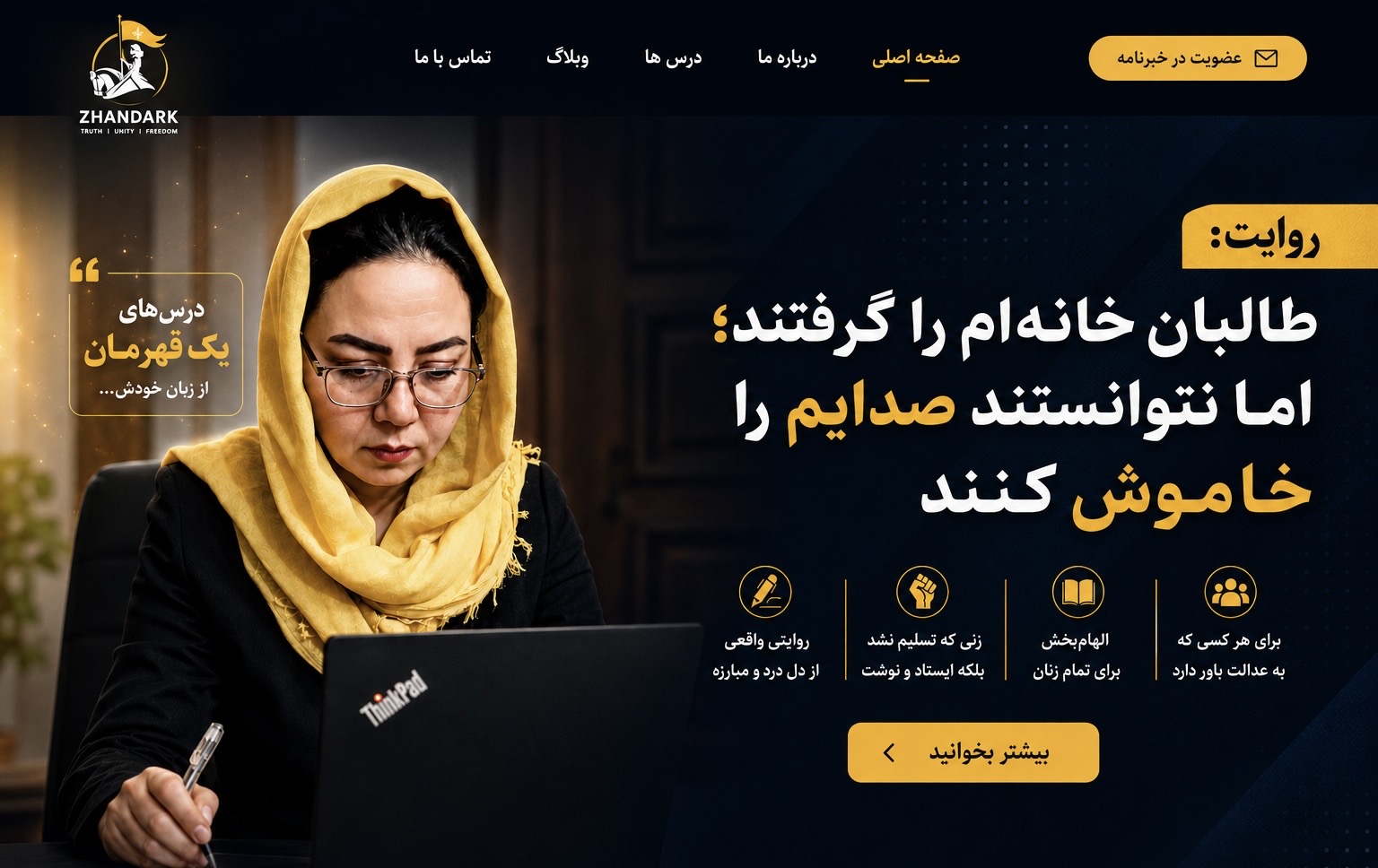
My name is Hamida Lassani; I am a journalist, women’s rights activist, president of the Empowered Women Organization, specialist at the Ministry of Urban Development, holder of a bachelor’s degree in journalism from Kabul University and a master’s degree in political science from Payame Noor University. A major part of my life has been dedicated to fighting for women’s right to education, right to participation, right to choice, and right to live; women who have always had to struggle for their most basic rights.
But the truth is that my life had already collapsed many times before the fall of Kabul, and each time I had risen again; although what happened in August 2021 was different.
I was born in Behsud district of Maidan Wardak province, into a Hazara and intellectual family; in a land where war decided children’s destinies before they even learned to speak. In the same year I was born, my uncle was arrested by the Afghan communist government, and for years no one knew what had happened to him.
In our home, politics was not just a topic of conversation; it was part of our everyday fear. I learned politics through the absence of people; through dinner tables with an empty chair and through women who silently cried so that children would not notice.
A few years later, insecurity and pressure forced my family to migrate, and we sought refuge in Iran. We sold everything we owned just to survive. I had not yet understood the meaning of migration when, at the age of six, I lost my father, and one year later my mother also passed away. My mother’s death marked the end of my childhood.
My younger sister and I suddenly found ourselves in a world where there was no shelter left. In my belief, an orphan is not only someone who has lost a father; an orphan is someone who has no one to rely on. We were both orphans.
I thank God that my brothers, sisters-in-law, and family did not leave us alone. They provided us with a home, food, and safety, but nothing can replace the absence of a father and mother. We learned very early not to ask for too much, not to cry too much, and not to be seen too much. Our childhood was more like a struggle for survival than a time for playing.
Perhaps that is why I grew up very quickly. After seventh grade, at the age of fourteen, I got married; at an age when I still needed someone to hold my hand and tell me that life was not frightening. But very soon, I entered a world where I had to take care of others.
When my children were born, I was still a wounded child myself who had never had the chance to experience childhood. My days were consumed by cooking, childcare, and household responsibilities, but something inside me had not died: my desire to study.
The turning point in my life was my mother-in-law; an aware and supportive woman who changed my path. Despite my husband’s opposition, she enrolled me in evening school. On the nights when I studied and my children woke up, she would quietly come, hold them in her arms, and say: “You study.”
That simple sentence changed the direction of my life. I have always believed that women should support each other; regardless of their role or position.
After returning to Afghanistan, I worked at the Ministry of Rural Development, studied journalism at Kabul University, and together with a group of women founded the “Empowered Women Organization.” Through media and programs, we spoke about violence, discrimination, and women’s challenges.
My goal was to show that a woman can be a mother, a student, and a leader at the same time; without one preventing the other.
But these activities made me a target for threats and attacks. I was attacked three times and later received a direct threat letter. The Taliban did not accept a woman like me; an independent, educated, and outspoken woman.
Despite all the threats, I still believed Afghanistan was our home and that we could fight to change it. When I was accepted for a PhD program in Iran, I thought my life was moving toward a brighter path. My children also each had their own journey.
But August 2021 destroyed everything.
Afghanistan did not only fall; the future collapsed. My daughters were prevented from continuing their education, and my children’s dreams remained unfinished. We were forced to flee.
The fall of Afghanistan was not only the fall of a government; it was the fall of thousands of lives. Women like me had spent years fighting so they could rebuild their lives, but everything collapsed within days.
We lived in Pakistan for two years. There too, I raised my voice against the Taliban through social media and gatherings. I still continue to fight, because this is part of my identity.
I started from evening school and continued until university, a master’s degree, and acceptance into a PhD program. In the mornings I was an employee, in the afternoons a student, and at night a mother. Many times, I fell asleep over my books from exhaustion, but I never gave up.
Today, we live in Germany; a safe but unfamiliar country. I have not yet continued my PhD, I no longer have my previous position, and I no longer have the stability I once had. Sometimes I feel that I have to start again from zero.
But when I look back at my past, I see that my life has always been this way: starting again after every destruction.
And perhaps the most painful truth about Afghan women is this: they lose everything many times, but they are still forced to rise again, rebuild their lives, and continue to hope.