
In this article
Commemoration of Rumi in Dushanbe; Tajik poets call for greater attention to Rumi's legacy
Literary gathering "Let's Appreciate Each Other" on the occasion of Maulana Jalaluddin Balkhi's commemoration day, with the presence of poets, writers, researchers, and artists
Tajikistan was held in the city of Dushanbe.
The ceremony was held on September 30 at the premises of the Union of Writers of Tajikistan, and participants discussed Rumi's place in Persian literature, his mystical thoughts, and the importance of this poet's legacy in the world.
They talked today.
Taleb Luqman, first deputy head of the Writers' Union of Tajikistan, said that for more than 800 years, Rumi has brought Muslims and followers of other religions "together at one table," and his ideas have transcended geographical boundaries.
To
According to him, celebrating Rumi's day has become a tradition in Tajikistan, and the Writers' Union is working to keep his name and memory alive.
Abdullah Rahnama, editor-in-chief of the weekly "Literature and Industry" and host of this event, also emphasized the importance of recognizing
And he emphasized support for the literary community.
Referring to the discovery of the "Spiritual Mathnavi" in the Western world, he said that for Persian speakers, in addition to the intellectual messages of this work, the language, art, and culture embedded in it are also of particular importance.
Golrokhsar: "You have to go on pilgrimage."
"Mawlana is gone."
Referring to her visit to Rumi's tomb in the Turkish city of Konya, Golrokhsar, the national poet of Tajikistan, expressed concern about the state of recognition and introduction of the poet's legacy.
He said that Rumi is still respected in Tajikistan as he deserves.
He is unknown, and poets, writers, and researchers should make more efforts to better introduce his works and ideas.
Golrukhsar suggested that a group of Tajik literary figures travel to Konya every year and hold Rumi reading gatherings at Rumi's tomb.
Hold.
He said, "The Maulana is a miracle that one must possess purity of intellect and thought to recognize and discover."
Emphasis on the scientific study of Rumi's works
Professor Shadi Mohammad Sofizadeh, a Tajik writer and researcher, spoke at this meeting about the necessity of studying
He emphasized the scientific nature of Rumi's works.
According to him, mystical experience is an internal and unrepeatable thing, but research on Rumi's works requires scientific method and precision.
He said that the meaning of Rumi's poetry cannot be sought in individual words alone,
Rather, the structure of poetry, the music of the words, and the relationship between its components must also be considered.
Soufizadeh also considered it necessary to use contemporary scientific theories, including Edmund Husserl's phenomenology, in studies related to Rumi, and urged researchers to:
Tajiks wanted to pursue more serious study and research on the poet's works.
Rumi; a symbol of cultural unity
Dr. Sahebnazar Moradi, an Afghan historian living in Germany and author of the book "Tajikans of Khorasan", also spoke at the event.
He/She/It
Referring to Rumi's place in Persian culture, he said that for many great figures of Persian-Tajik culture, it is possible to find counterparts, but for Rumi it has been difficult to find such a counterpart.
Moradi also paid more attention to Rumi studies and
He considered the study of Bedel to be important in Tajikistan and considered Rumi to be one of the symbols of cultural unity and solidarity of the people of this civilizational area.
Poetry reading and music performance
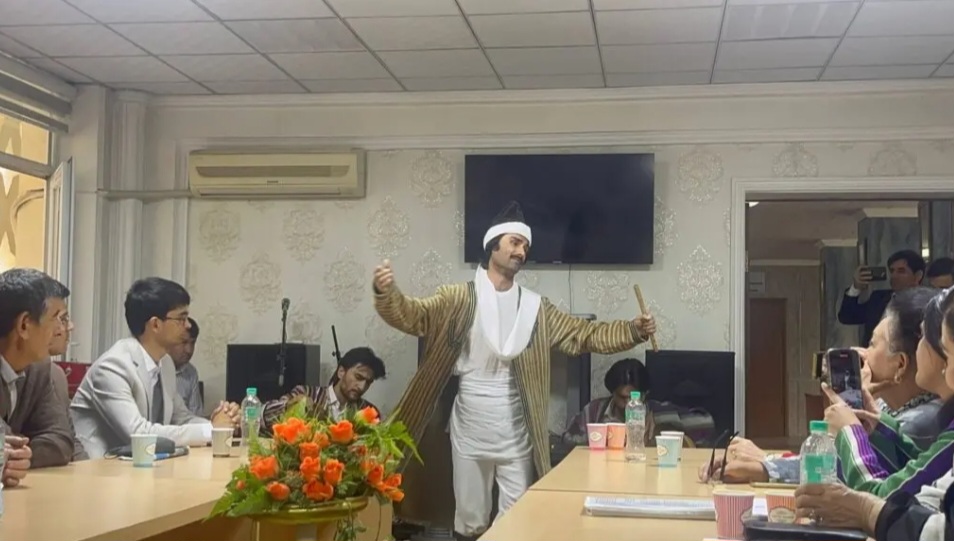
In the artistic part of the ceremony, a group of theater artists performed part of a play based on the works of
They performed Rumi.
Artig Kadyrov and Shahmurad Ayubov, two artists from the Lahuti Theater, recited poems by Rumi for the audience. Ebadullah Mashrib and Akbar Abdullah also performed songs based on Rumi's poems, providing the musical accompaniment for the event.
They held.
September 30; Rumi Commemoration Day in Tajikistan
In Tajikistan, September 30 is celebrated every year as the Day of Commemoration of Maulana Jalaluddin Balkhi. This event was established by a decree of the President of Tajikistan in 2009.
It has been formalized.
UNESCO also declared 2007 the year to commemorate the 800th anniversary of Rumi's birth, the year to commemorate this famous poet and mystic.
In 2022, a symbolic tomb will be built by transferring some soil from Rumi's tomb in Konya, Türkiye.
It was built for him in the Jalaluddin Balkhi district of Tajikistan. The complex includes a statue of Rumi, a symbolic tomb, and Rumi's house.